

At this year’s Google I/O, CEO Sundar Pichai didn’t just announce updates; he described a period of “hyper-progress” that is fundamentally remapping the geography of the digital world. The most staggering evidence of this acceleration lies in a single metric: Google is now processing 3.2 quadrillion tokens every month. To put that in perspective, that is a seven-fold increase in just one year.
As a strategist, I look at that number and see more than just raw compute. It signals a phase shift in human-computer interaction. We are moving from a world where we “ask” AI for information to a world where AI “does” work on our behalf. This is the official transition from AI as a tool to AI as an agent—the birth of the “Agentic Gemini Era.”
The Death of the Static Search Box
For over twenty-five years, the Google Search box was a static gateway to links. That era ended today with the debut of the Intelligent Search Box. This isn’t just an aesthetic refresh; it is a total reimagining of the interface using a new design language called Neural Expressive. The box now expands with user curiosity, moving beyond autocomplete to offer nuances and “mini-apps” built on the fly.
Instead of merely retrieving web pages, Search now functions as a real-time developer. Using the agentic coding capabilities of Gemini 3.5 Flash, it builds custom interactive widgets and stateful dashboards—like a weekend family planner that syncs with your calendar and checks weather-impacted driving times—directly in the results. Crucially for the security-conscious, these experiences aren’t just “faked” text; the code is executed in a secure, containerized environment, ensuring that the agent’s actions remain private and safe.
“This is the biggest upgrade to our iconic Search box since its debut over 25 years ago.” — Liz Reid, VP of Google Search
The $1,000 Operating System: The Death of the Developer Bottleneck
The most disruptive moment of the keynote centered on Antigravity 2.0, Google’s standalone agent-first development platform. In a feat that would typically take human engineering teams months of “notoriously brutal” labor, an autonomous team of 93 subagents built a functioning operating system from scratch in just 12 hours.
The total cost? Less than $1,000 in API credits.
This was made possible by Gemini 3.5 Flash, which has been co-optimized with the Antigravity Agent Harness to deliver a 12x speed increase within the development environment. This reveals the “Efficiency Paradox” Google is solving: by moving from “brute force” large models to high-speed, agent-optimized Flash models, they are making complex agents economically viable at scale. Google estimates that if enterprises shifted 80% of their workloads to Flash, they could save over $1 billion annually. We are entering an era where software development is no longer a function of human capital, but of agentic orchestration.
Your 24/7 Digital Employee: Gemini Spark and the Commerce Backbone
Google’s direct play for the consumer agent market is Gemini Spark. Unlike standard chatbots, Spark runs on dedicated virtual machines in Google Cloud, operating 24/7 in the background even when your laptop is closed. It acts as a “digital employee,” handling long-running tasks like managing block party RSVPs or proactively ordering groceries.
However, the real strategic “unlock” here is the Universal Commerce Protocol (UCP). Think of UCP as the “HTTP of shopping”—an open-source standard recently joined by Amazon, Meta, and Walmart that allows agents to communicate across different retailers. When paired with the Agent Payments Protocol (AP2), which sets strict spending boundaries and provides a “permanent digital paper trail,” Google has built the infrastructure for truly autonomous commerce. This level of utility comes with a premium “strategist” price tag: Google is launching a new $100/month Ultra plan to support the high compute costs of this 24/7 background actuation.
AI You Actually Want to Wear: The Fashion-First Wearable Strategy
Google is finally tackling the “wearable adoption” problem by prioritizing aesthetics through an all-star partnership with Samsung, Qualcomm, Warby Parker, and Gentle Monster. Arriving this fall, the new line of intelligent audio glasses replaces bulky displays with “heads-up, hands-free” utility.
By prioritizing “prettiness” and iconic design over the cyborg-like displays of competitors, Google is betting on ambient AI that fits into a social context. These glasses function as an extension of Gemini’s vision, allowing users to interact with the world through voice. During a live demo, the glasses identified a coffee shop and automatically placed an order for a “nitro cold brew” via Doordash through the UCP backbone—all without a phone ever leaving a pocket. It is a bold move to win the face by making the technology invisible.
Science at “Digital Speeds”: Simulating Reality
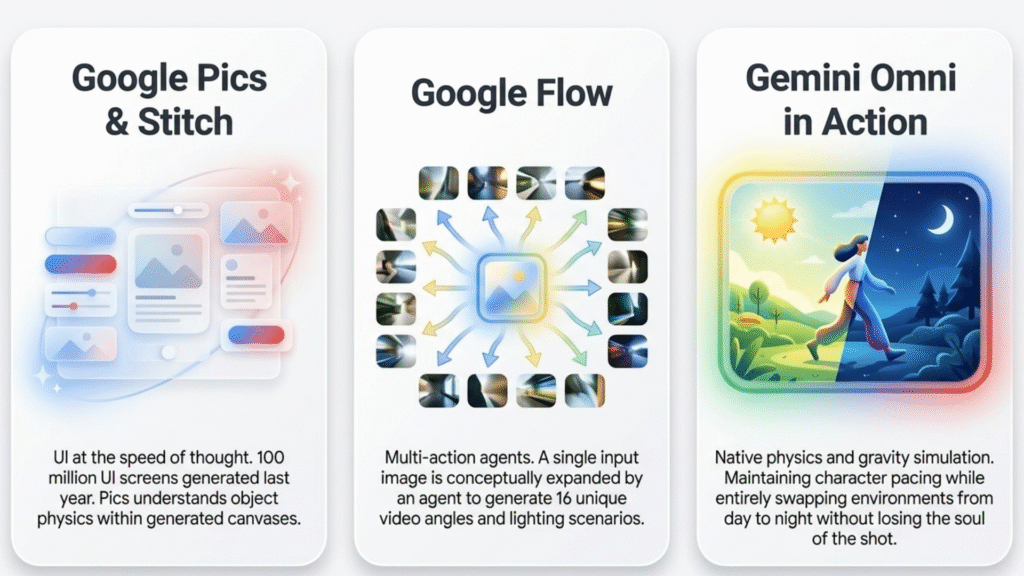
Perhaps the most profound takeaway is AI’s evolution from predicting text to simulating world physics. Gemini Omni, acting as a “World Model,” understands kinetic energy and gravity, allowing it to simulate complex systems rather than just describing them.
This capability is fueling “science at digital speeds.” We saw this in WeatherNext, a model that predicted Hurricane Melissa—a Category 5 storm striking Jamaica—three days earlier than traditional systems, potentially saving thousands of lives. Demis Hassabis and Isomorphic Labs are now using this same simulation power to model molecular interactions with the goal of “solving all disease.”
“I like to call this ‘science at digital speeds,’ both in terms of the speed of the solution and its dissemination to the researchers who can make use of it.” — Demis Hassabis, CEO of Google DeepMind
Conclusion: Standing in the Foothills of the Singularity
Google I/O ‘26 made one thing clear: the “Agentic Gemini Era” is the new baseline. From Search boxes that code their own UI to autonomous subagents building operating systems in half a day, the pace of progress has hit an inflection point.
As Demis Hassabis noted in his closing remarks, we are currently “standing in the foothills of the singularity.” The tools of yesterday have become the agents of today, capable of proactive thought, background execution, and independent action. We are no longer just users of technology; we are managers of digital entities.
Which part of your life—your schedule, your shopping, or your professional legacy—are you most ready to hand over to a 24/7 agent?

